
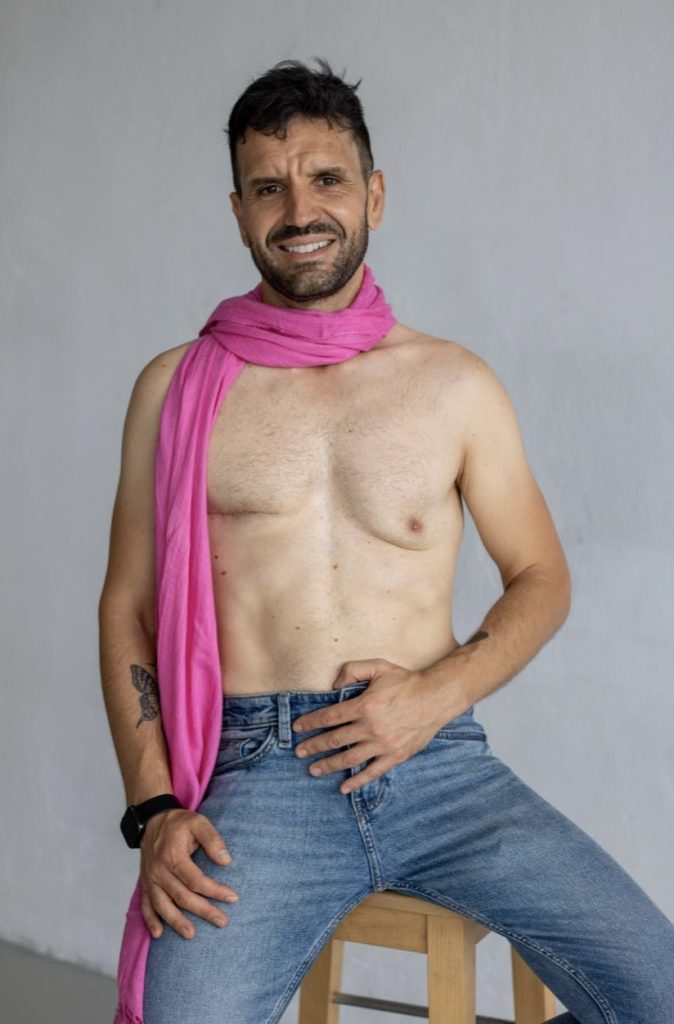
In April of this year, while I was in the shower, I noticed a lump behind the nipple of my right breast, a little bigger than the size of a lentil. At first, I thought it was nothing more than any other accumulation of fat that we can have in our body, but I decided to go to my family doctor anyway.
The doctor considering my family history (my mother had breast cancer in 2013 and my father passed away last Christmas from a stomach tumor), referred me to a specialist for further tests.
A month later, I had a mammogram and a biopsy and, at first, the doctors told me to stay calm, that, without having to analyze it, they were almost certain that it was something fat. I didn’t give it much thought, but one day, while I was in bed, I dreamed that it was malignant, so in the following days I was waiting to see if the results would appear in my Osakidetza health file.
One of those days, when I checked my health record, I found the test results and a message that said “Pending evaluation by the committee of doctors of the oncology team.”
I learned that it was invasive ductal breast cancer (the most common type of breast tumor). I told my family, friends, and people close to me, and, still in shock, I felt immensely grateful and privileged to receive so many displays of affection, messages, and calls, and how they looked after me throughout the entire process.
I was given an appointment at the Cruces hospital and on June 11th I had surgery to remove part of my breast tissue. Although I had to wait a little over a week to find out the results of the samples taken and analyzed (with the resulting uncertainty), fortunately for me, the sentinel nodes were not affected and there was no trace of metastasis, so I did not have to receive chemotherapy or radiotherapy, only hormonal treatment for 5 years, taking a daily Tamoxifen pill.
After my surgery, the genetic analysis center in Cruces offered me the necessary tests to find out if my cancer was hereditary. The results confirmed a mutation in the BRCA2 gene, so it is of genetic origin, in my case, it is important to have annual prostate and breast check-ups.
I would like to thank all the medical professionals for their work, every one of the people who have been and continue to be by my side, encouraging me and looking out for me, and above all, the INVI ASSOCIATION (“making the invisible visible”), the only foundation in Spain dedicated to Male Breast Cancer, and ACAMBI (Breast Cancer Association of Bizkaia), for having welcomed me with open arms and having accompanied me throughout the entire process of the disease, giving me all their help.
Finally, I would like to send a message of awareness to all people that breast cancer does not distinguish between genders or ages, both men and women can suffer from it and that is why visibility, prevention, and self-examination are very important since the sooner the tumor is detected and the earlier the stage it is in, the better the results and chances of cure and the less invasive the treatment to follow.